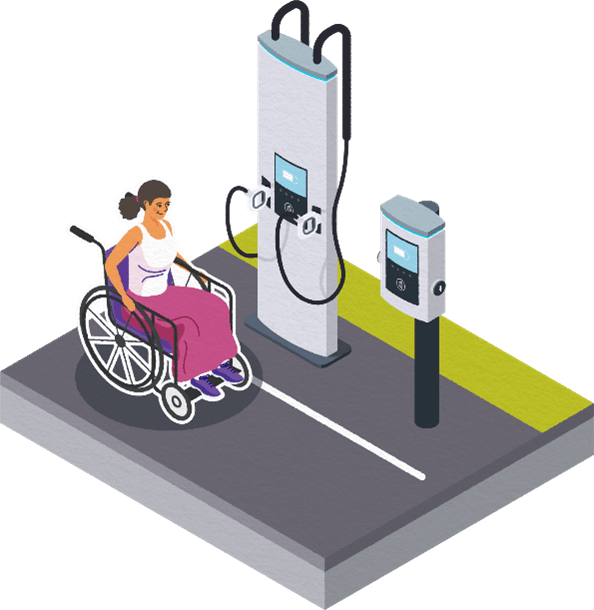
It’s predicted that by 2035, the number of disabled drivers and passengers in the UK will reach 2.7 million. With the sale of brand new petrol, diesel and hybrid vehicles ending in 2030, the transition to electric vehicles (EVs) must be accessible for everyone.
In October 2022, the British Standards Institution launched an accessible chargepoint standard called PAS1899. The standard sets out the minimum specification for an accessible public chargepoint. It provides designers, procurers, and installers with the requirements and recommendations to provide accessible public charging infrastructure for EVs.
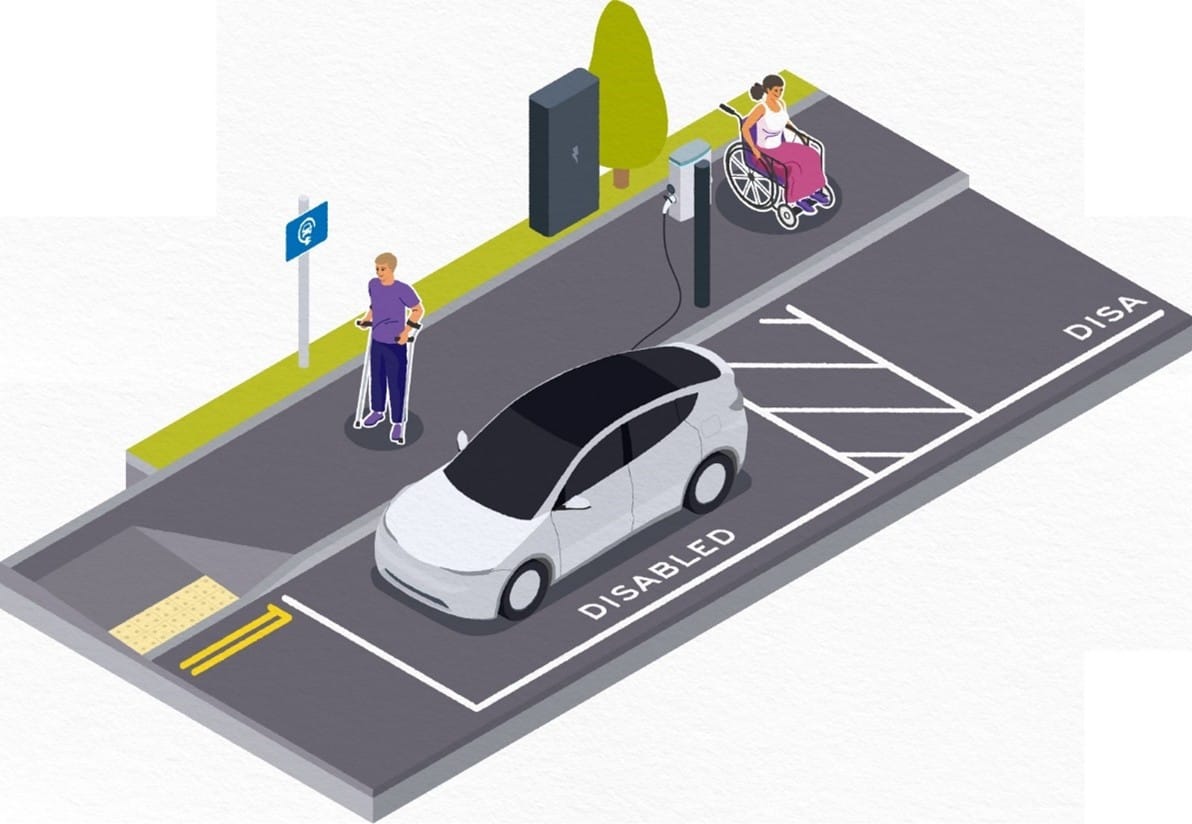
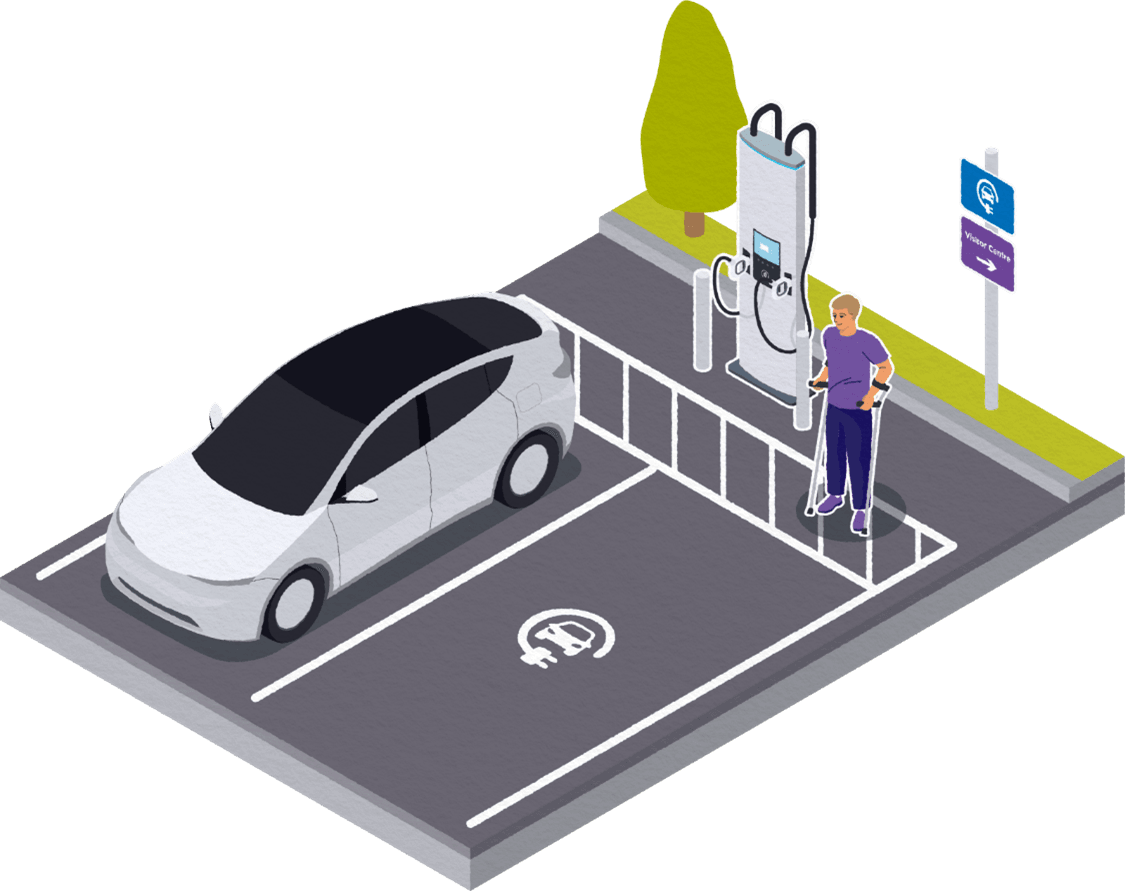
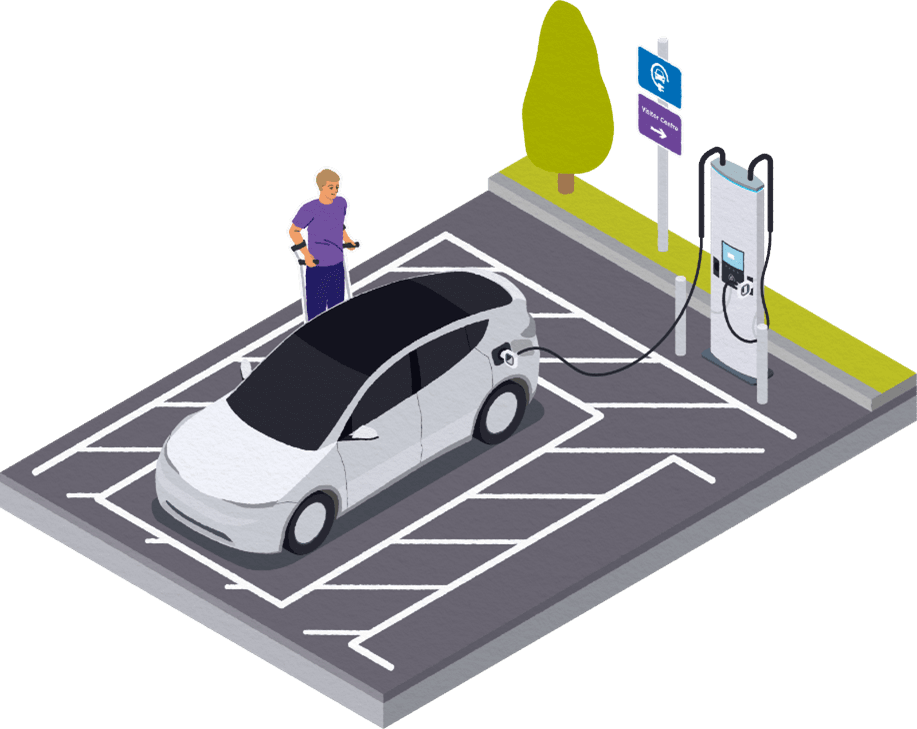
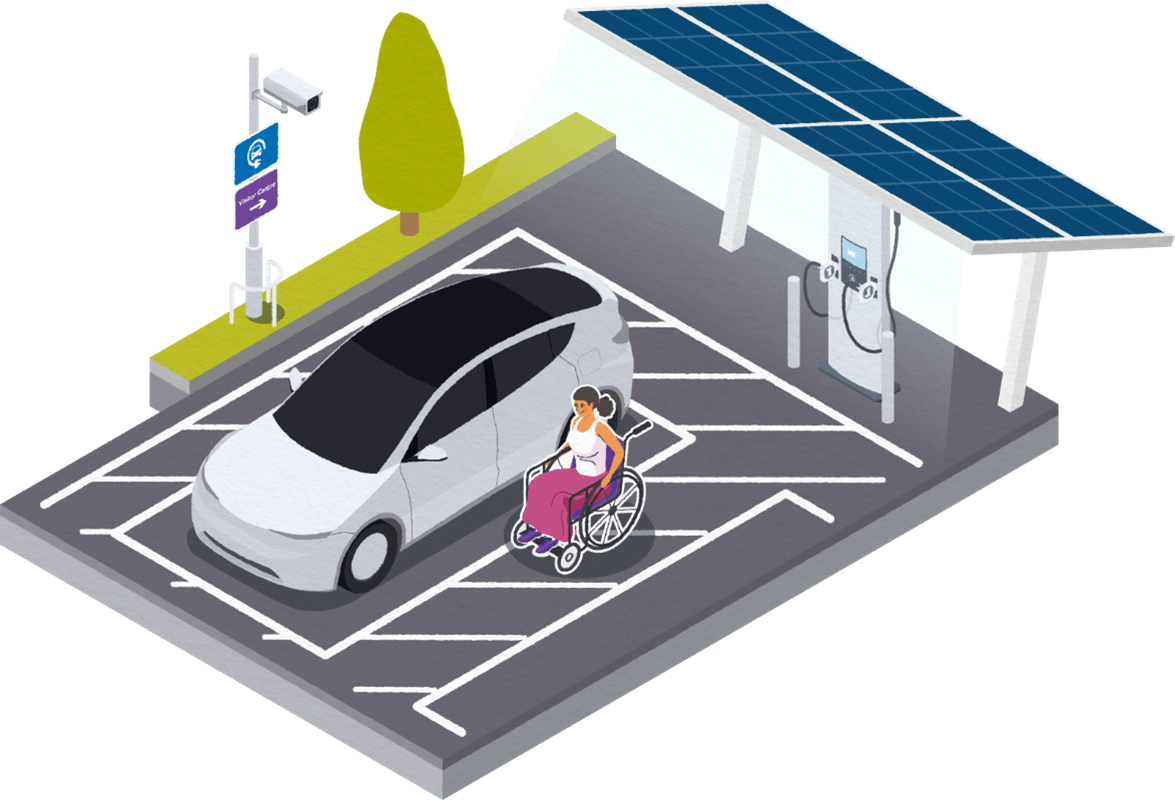
The following set of illustrations have been created to help demonstrate compliance with the minimum requirements and the best practice requirements of PAS1899 in on-street and off-street locations.
There will be some changes coming to PAS1899 later in 2026, but the following guidance is still relevant to anyone currently looking to design and install accessible EV infrastructure.
As the PAS 1899 standard is currently being revised and there will be changes to the minimum requirements for on-street locations, we have only provided best-practice recommendations here.
Key considerations are:
There is sufficient space and stable ground to safely exit and move around the vehicle.
Bay size is minimum 4000mm (width) x 6600mm (length) and considers parking provision and accessibility guidance in BS 8300-1:2018, Clause 7 and Clause 8, along with the UK Government’s Inclusive Mobility guidance.
Provide 1600mm marked access zones between bays.
Ground surface surrounding the chargepoint is flat, smooth, stable, and slip-resistant.
Surface water drainage is achieved with a fall no steeper than 1:50.
Chargepoints are positioned and orientated so that they can be used by everyone.
Chargepoint components can be easily viewed, reached, and operated from a seated or fully standing position, by providing a space of 1850 mm in front of the points of access to the chargepoint components.
Dropped kerbs are provided
If the chargepoint is installed at footway level and any of the components cannot be accessed or used from carriageway level, a dropped kerb will be provided where no existing dropped kerbs or pavement access areas exist.
Dropped kerbs and tactile paving provided where necessary within a max. of 20m.
Obstacles are minimised and can be seen easily.
If possible, chargepoint placement is achieved without any low-level obstacles in front of the points of access to chargepoint components.
Where bollards are used (preferred protection method), they are at least 1000 mm high and allow min. 1400 mm between centres to provide sufficient space for use of chargepoint.
Where there are unavoidable low-level obstacles in front of the chargepoint (for example: kerbs, impact protection barriers, manhole covers), all chargepoint components shall be at a reach distance not exceeding 220mm.
Chargepoints do not compromise accessibility of the surrounding environment.
Installed in a prominent location and easily detectable by visually impaired users.
Position chargepoints to avoid obstructing the footpath with a minimum footway width of 1500mm must be provided as per UK Government’s Inclusive Mobility guidance.
Chargepoint is easily identifiable by road markings and signage.
Use line markings (e.g. a hatched pattern) or visual contrasts (e.g. colour) to distinguish charging bay access zones from the vehicle bay.
If chargepoint is located near amenities; then it should be placed in close proximity to the venue in prominent and visible locations.
Position chargepoints close to associated amenities, following BS 8300-1:2018, Clauses 9 and 10, and the UK Governments Inclusive Mobility guidance, Section 8.4.
Ensure safe and clear route to amenities.
Key features to avoid:
Avoid using any unnecessary obstacles that obstruct the reach and movement of users of the chargepoint.
Avoid creating unnecessary obstacles for pedestrians, such as trailing cables.
Avoid orientating the chargepoint components so that the user is positioned in the road.
Key considerations:
There is sufficient space and stable ground to safely exit and move around the vehicle.
Bay size is minimum 2.4m (Width) x 4.8m (Length) and considers parking provision and accessibility guidance in BS 8300-1:2018, Clause 7 and Clause 8, along with the UK Government’s Inclusive Mobility guidance.
Ground surface surrounding the chargepoint is flat, smooth, stable, and slip resistant.
Surface water drainage is achieved with a fall no steeper than 1:50.
Chargepoints are positioned and orientated so that they can be used by everyone.
Chargepoint components can be easily viewed, reached, and operated from a seated or fully standing position, by providing adequate spacing in front of the points of access to the chargepoint components; minimum 1200mm.
Obstacles are minimised and can be seen easily.
If possible, chargepoint placement is achieved without any low-level obstacles in front of the points of access to chargepoint components.
Where there are unavoidable low-level obstacles in front of the chargepoint, such as kerbs, impact protection barriers, manhole covers, all chargepoint components shall be at a reach distance not exceeding 220mm.
Dropped kerbs provided.
If the chargepoint is installed at footway level and any of the components cannot be accessed or used from carriageway level, a dropped kerb will be provided where no existing dropped kerbs or pavement access areas exist.
Dropped kerbs and tactile paving provided where necessary within a max. of 20 m.
Chargepoints do not compromise accessibility of the surrounding environment.
Installed in a prominent location and easily detectable by visually impaired users.
Key features to avoid:
Please avoid using any unnecessary obstacles that obstruct the reach and movement of people.
In addition to the minimum requirements, the key features to include:
There is sufficient space and stable ground to safely exit and move around the vehicle.
Provide 1600mm marked access zones at the sides of bays (this can be shared by adjacent bays).
Provide 1200mm marked access zone at the rear of the bay.
Chargepoints are positioned and orientated so that they can be used by everyone.
Chargepoint components can be easily viewed, reached, and operated from a seated or fully standing position, by providing a space of 1850 mm in front of the points of access to the chargepoint components.
Obstacles are minimised and can be seen easily.
Where bollards are used (preferred protection method), they are at least 1000 mm high and allow min. 1400 mm between centres to provide sufficient space for use of chargepoint.
Bollard spacing can be reduced to 1000mm if not protruding from chargepoint more than 250mm
Additional assistance should be available for users if they require support with heavy cables.
Additional assistance provided where necessary, especially for higher-powered chargepoints.
Dropped kerbs provided.
If the chargepoint is installed at footway level and any of the components cannot be accessed or used from carriageway level, a dropped kerb will be provided where no existing dropped kerbs or pavement access areas exist.
Dropped kerbs and tactile paving provided where necessary within a max. of 8 m.
Chargepoint is easily identifiable by road markings and signage.
Use line markings (e.g. a hatched pattern) or visual contrasts (e.g. colour) to distinguish charging bay access zones from the vehicle bay.
If chargepoint is located near amenities; then it should be placed in close proximity to the venue in prominent and visible locations.
Position chargepoints close to associated amenities, following BS 8300-1:2018, Clauses 9 and 10, and the UK Governments “Inclusive Mobility” guidance, Section 8.4.
Ensure safe and clear route to amenities.
In addition to the PAS 1899 guidance, the additional best practice considerations are:
There is sufficient space and stable ground to safely exit the vehicle and access the chargepoint.
In addition to the PAS 1899 guidance, a minimum 900mm spacing is provided between bays.
Chargepoints are well-lit for safety and ease of use.
Ensure safe vehicle navigation to chargepoints.
Illuminate chargepoints, their surroundings, and user interaction points.
Illuminate routes from chargepoints to nearby venues or amenities.
Chargepoint locations are staffed, and security cameras are provided to ensure user safety.
Security cameras are installed near to chargepoints, or existing ones are utilised.
Cameras are visible to indicate protected areas and properly maintained.
Sufficient lighting ensures cameras can capture the area in all weather conditions.
Clear and accessible signage for chargepoint instructions and location.
Signage in public car parks indicate chargepoint-enabled bays.
Signage is visible from seated or standing positions and from inside vehicles.
Signage placement does not obstruct footpaths or built environment access and minimises injury risks to users and passers-by.
Design adheres to BS EN 17210:2021, 6.6 (text size, font, colour, contrast, layout).
Charging process signals are intuitive and easy to understand.
Chargepoints provide clear feedback during the charging process:
Indicates initiation orconclusion of certain stages of the charging process.
Confirms successful actions such as removing or plugging in connectors, payment.
Uses tactile, audible, or visual feedback.
Visual feedback, such as lighting, is visible even in direct sunlight.
Users are given sufficient time to complete setup processes without system time-outs.
Overhead weatherproofing protects users from the elements.
Provide overhead protection from adverse weather conditions that covers higher-powered chargepoints and access routes to amenities or buildings.
Key features to include:
Tethered cables are easy to handle and do not create further obstructions.
Cable length accommodates a variety of parking positions without obstructing the existing streetscape.
Cable is managed to avoid trip hazards.
Charging cables and handles are simple to locate back into their holster.
Force to extend and handle charging cable: max. 60 N at 4m extension.
Connectors require minimal effort to use.
Connectors and sockets are operable without excessive force (max 60N)
Connectors and sockets are designed to enable one handed operation.
Connectors are ergonomically designed for all users to use comfortably.
Connector grips are suitable for users with strength or dexterity impairments.
Grip diameter: 19-43 mm.
Connector design ensures clear visibility and ease of use.
Chargepoints with visual interfaces must make sure they are user-friendly and easy to read.
Readable from standing and seated positions.
Tilted zero degrees to 20 degrees upwards for readability.
Content is produced in easily understandable language and designed for accessibility, including for vision impairments and colour blindness.
Visible in outdoor conditions and illuminated for easy identification.
Digital platforms help provide a seamless consumer experience before and during charging.
Chargepoint interaction is supported by a remote digital platform, such as an app.
Data regarding chargepoint accessibility is openly available to consumers.
Payment processes have accessible alternatives, such as contactless.
In addition to the minimum requirements, the key features to include:
Chargepoint components are positioned at inclusive heights for all users.
Chargepoint socket height: should not exceed 950mm (ideal range would be 800-850, stretch range 750-950)
Tethered cable connector handle height: ideally at 800mm and should not exceed 900mm.
Screen/visual interface height: bottom at 750 mm, top at 1300 mm.
Interactive screen elements height: 750-1200 mm.
Payment terminal bottom height: 750-1200 mm.
Please note: the heights specified should be measured from the surface where the user will operate the chargepoint.
Review of PAS 1899 and proposed changes
PAS standards typically undergo a review after two years to assess whether and how they might be updated to improve their implementation.
A PAS 1899 Technical Working Group was established to examine the emerging evidence of challenges to implementation, and to provide advice on whether and how to update PAS 1899 to improve its effectiveness and implementation.
It was agreed that there should be focused updates to some of the technical clauses within PAS 1899, namely those on: component heights, bollard spacing, connector forces, and cable weights.
Availability of assistance
PAS 1899 requirements on availability of assistance should be updated following further engagement with the sector. This will support the improved provision of physical assistance where it is needed, while ensuring that this is feasible to deliver in practice.
On-street chargepoints
It was agreed that designated on-street (and off-street) accessible chargepoints should have core minimum requirements, rather than just guidance.
For other types of on-street chargepoint, it is recommended that an amended approach should be taken that reflects the variability of the local environment. It is proposed that this should include a smaller set of requirements applicable to all on-street chargepoints, together with guidance on issues that are likely to be more site specific such as dropped kerbs).
Structure and drafting
PAS 1899 should be split into two different parts, one focused on on-street chargepoints, and the other focused on off-street chargepoints.
PAS 1899 should also be updated to reflect feedback from stakeholders, including the addition of further diagrams to aid understanding, and ensuring that the distinction between requirements and guidance is clear.
Supplementary guidance
It was agreed that easy-to-understand guidance should be developed alongside PAS 1899 to support its implementation, including clarifying roles and responsibilities.
Chargepoint accessibility data
An accessible chargepoint data standard should be developed by the time the revised PAS is issued. It is proposed that the use of the data standard should be a requirement of PAS 1899.
This standard would enable CPOs to share data on the accessibility-related features of their chargepoints and the surrounding built environment in a consistent manner.
OCPI Accessibility Extension
Open Charge Point Interface (OCPI) is an open communication protocol specifically designed for EV charging. Its purpose is to make it easier for EV drivers to find and use charging stations, by facilitating communication between eMobility service providers who have EV drivers as customers, and chargepoint operators who manage charging stations.
The OCPI Accessibility Extension aims to ensure that disabled people can determine whether a charging station can be used according to their individual accessibility needs.
The accessibility challenges that drivers may encounter have been identified and consolidated into four accessibility aspects.
Provide drivers with accessibility information about the facilities and assistance services available at a charging location, enabling them to determine in advance whether the location meets their accessibility needs.
Provide drivers with accessibility information about the safety and security conditions at a charging location, enabling them to determine in advance whether the environment supports safe use of the charging infrastructure
Provide drivers with accessibility information about the parking space enabling them to determine in advance whether they can enter and exit their vehicle and move safely and independently between the vehicle and the charging station.
Disability types: mobility, dexterity
Information items:
Parking space width
Parking space length
Protected area available
Surface
Slope
Step-free access
Parking direction
Charging station position
Parking restrictions
Standards
Photos
Provide drivers with accessibility information about the reachability, operation, interaction, and timing of the charging equipment, enabling them to determine in advance whether they can independently access, connect, and operate the charging station.