Check whether you need permission to install plug-in solar panels before you buy.
Make sure your property and electrics are suitable.
Install the panels safely and register your system after installation.
If you live in England, Scotland or Wales, plug-in solar will be available to buy from 27 August 2026. Northern Ireland may follow once regulations are updated. Use this guide to help you find out more, including about getting permissions depending on where you live.
Plug-in solar panels are a lower cost way to generate electricity than rooftop solar panels.
Make sure you buy a UK-compliant plug-in solar panel device from a registered seller. And before you buy, make sure you’re able to install the plug-in solar panel device safely and legally.
Since plug-in solar is new to the UK, we appreciate you may have more questions. If you have a question that isn’t answered here, get in touch. We’ll collect all questions related to plug-in solar panels with an aim to update this guide as more information becomes available.
1. Check if you need permission to install plug-in solar panels
Don’t buy plug-in solar panels before getting relevant permissions.
If you buy and install a plug-in solar panel without relevant permission, you may be required to remove the panels and pay for any damage caused. This is the same as with satellite dishes, EV charge points and air conditioning units.
Tenants, leaseholders, residents of managed buildings
Get permission from whoever’s responsible for the building before buying. This could be your landlord, freeholder or building manager (property manager in Scotland). It’s worth getting explicit permission if you:
Plan on drilling into walls to install brackets.
Need to install an external mains socket for your plug in-solar panel device.
If you own your own flat, check your lease agreement for:
Needing permission to fix equipment to your balcony, external walls, roof, railings or communal areas.
Restrictions that could impact the building’s fire safety or insurance.
Restrictions on making alterations to the outside of the building or communal areas.
Do I need planning permission?
Depending on where you live, you may need planning permission before installing:
For England – the UK Government has introduced a Permitted Development Right to make it easier to install plug-in solar panels on houses.
For Scotland – check the requirements that apply in your area before installing.
For Wales – check the requirements that apply in your area before installing.
For Northern Ireland – Plug-in solar panels aren’t currently permitted for use.
If you live in a listed building or conservation area, check with your local authority or planning office to see if you need planning permission.
Safety requirements and insurance
Check with your local authority about any building, fire or electrical safety concerns or legal requirements before you buy.
You should also contact your buildings and contents insurance provider to see how plug-in solar panels might affect your policy. Check whether your policy includes outdoor installations.
2. Check that your property and electrics are suitable
These are some essential questions before installing any plug-in solar panels:
Is my location suitable?
Plug-in solar panels work best on an unshaded, south-facing spot.
Panels facing east or west still work but will generate less electricity. We don’t recommend installing panels that face north or are in a shaded space.
Is my building suitable?
Flats, apartments and ‘higher-risk buildings’ may have other rules due to fire safety concerns. They may need to consider how the installation affects the building’s fire risk assessment.
The definition of a higher-risk building varies across UK nations. If you’re not sure whether your building qualifies, check with your local authority or building manager (property manager in Scotland).
Does the building have external cladding or timber balconies, or is undergoing work on the external walls?
Speak to your building manager (property manager in Scotland) before installing plug-in solar panels, as these could impact fire safety. This is particularly important if your building has combustible cladding or has undergone remediation work.
Do I have a suitable socket to plug the panels into?
Plug-in solar panels need to be plugged in directly to a mains socket. This is ideally an outside socket, but it could be inside.
You can’t use an extension lead, so your choice of location is important. The length of the cable is also important as you need to make sure it will reach directly into a socket. The socket has to be in a circuit that doesn’t have lighting or hardwired appliances e.g. a boiler or cooker.
Outdoor sockets need to be weatherproof and installed by a qualified electrician.
Is my electrical system suitable?
You should have your electrical system inspected every 10 years (every five years for tenants) to make sure it’s modern and safe.
Speak to a qualified electrician if:
Your electrical consumer (fuse box) unit has older, rewireable fuses.
You’re not sure about the condition of your wiring.
You need to move or install a new socket.
If the total power of the solar panels is more than 960W.
You can find local, qualified electricians using Trustmark – a government-endorsed quality scheme.
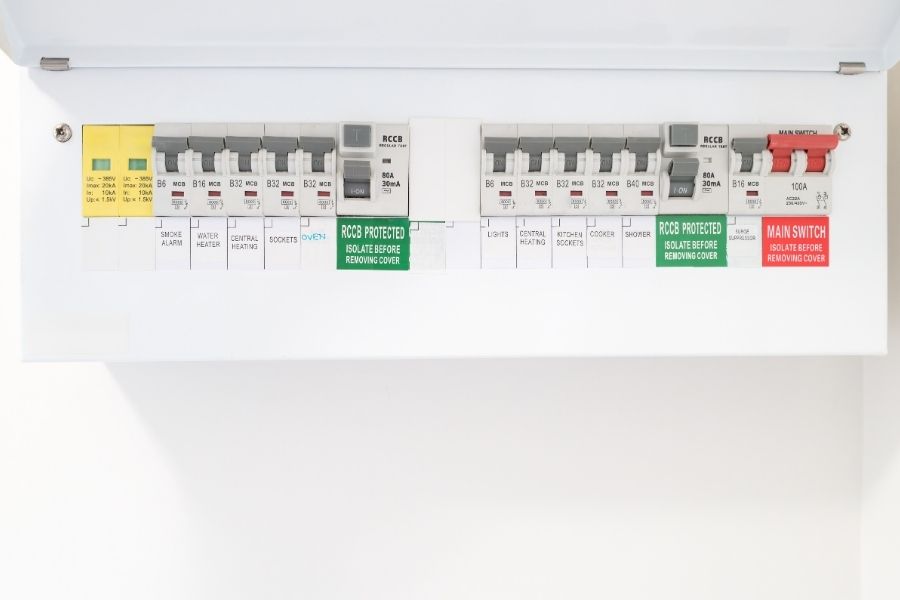
Modern consumer units typically have a row of switches called circuit breakers. Each circuit breaker protects a different group of sockets, lights or appliances. If there’s a fault, the device automatically switches off (‘trips’) the electricity supply to that circuit.
You can turn individual circuit breakers on and off and are usually labelled to identify the circuits they protect.
Look for switches labelled ‘RCD’, ‘RCBO’ or ‘MCB’. These indicate that your consumer unit has the electrical safety protection needed for plug-in solar panels.
An example of a modern consumer unit
Older consumer units have rewireable fuses or fuse carriers instead of individual switches. They may not provide the same level of protection or make it easy to identify individual circuits.
If your consumer unit uses older style fuses, don’t install plug-in solar panels.
Are my plug-in solar panels compliant with UK standards?
Make sure the specific model you’re looking at is on the list of devices that meet UK standards. You can look for your model on the ENA Connect Direct LCT Device Register.
Other considerations
Make sure you’re aware of any specific considerations regarding your plug-in solar panels, including:
warranties
insurance
repairs
theft
disposal and recycling
For more information, check the product information on the panels you want to buy.
3. Install the plug-in solar panels safely
Make sure you install your plug-in solar panels in line with the manufacturer’s instructions.
There are also several safety considerations to keep in mind:
Building safety
Use an appropriate frame, fixing or anchors so the panels are secure and can’t move or blow over during strong winds. Don’t install plug-in solar panels on wooden fences unless you get advice from a professional to ensure that it’s safe.
If you’re installing panels on a garage or outbuilding, make sure the roof is strong enough to take the weight of the panels. If you’re unsure, get professional roofing advice.
Take care when drilling into walls to install brackets. Be aware of pipes or cables in the walls, and suitable seals where needed to prevent damp and mould.
Any fixtures should be non-permanent and shouldn’t damage the building, affect fire safety or damage any weatherproofing. If installing the panels does impact these areas, it may be classed as ‘building work’. This means you’ll need to adhere to Building Regulations, even if formal consent is not required. This varies across UK nations. Check with your local building control before installation for advice.
Make sure you keep all cables tidy and secure to avoid trip hazards or accidental disconnection.
Electrical safety
Only connect one plug-in solar panel device per property.
Use a socket that’s connected to a circuit that doesn’t also control lighting or hardwired appliances e.g. a boiler or cooker. To find out which circuits are suitable, switch off one circuit breaker at a time and check which appliances are affected. If you’re unsure, speak to a certified electrician.
Plug the panels directly into a suitable socket (indoor or outdoor). Don’t use extension leads, international adaptors or altered plugs.
If your socket is outdoors, make sure the socket is suitable for outdoors and installed by a qualified electrician. A rating of at least IP65 means that it’s adequately protected against water and dust.
Don’t modify the device or link multiple devices together. You might read this being called ‘daisy-chaining’.
Test your circuit breaker protection every six months by pressing the ‘test’ button on your electrical consumer unit, if you have one. Do this during the daytime while the panels are generating electricity. If the circuit breaker doesn’t trip, unplug the device and speak to a qualified electrician.
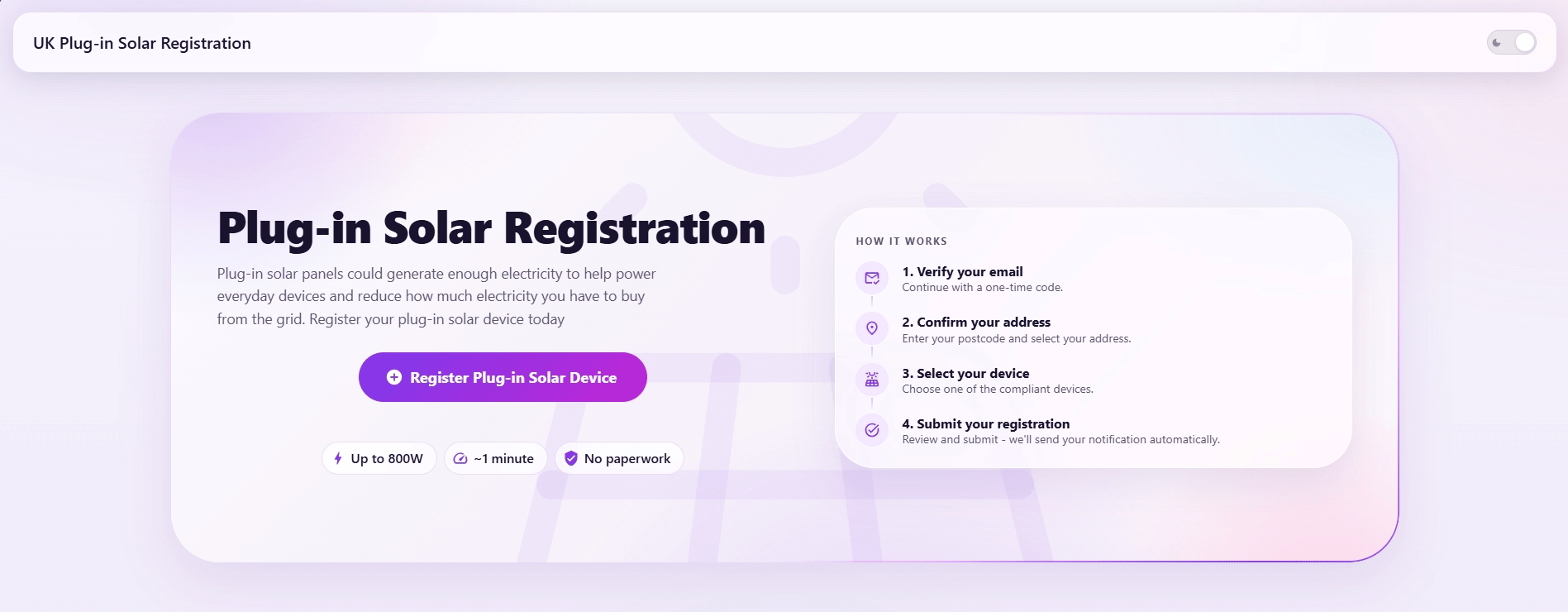
Registering your plug-in solar panels is a legal requirement. It also ensures the energy network can handle the extra electricity flowing into the system.
This is due to current regulations. This restriction may change in future, but the regulations need to be updated to allow this.
If you have a property factor then it would be best to approach them in the first instance. If you do not have a factor then the local authority may be able to assist on statutory compliance.
The current regulations say that 800W is the maximum amount of power allowed to enter your home’s electrical socket. All compliant devices sold in the UK are capped at 800W.
However, the panels themselves may be able to generate more than that. For example, if your plug-in solar panel device includes two panels of 450W each.
If this happens, the microinverter connected to the panels limits the maximum output to 800W. Some manufacturers call this ‘clipping’.
This is usually possible. You should speak to the original installer or a qualified electrician to check that your new plug-in solar panels won’t overload your system. You may need to notify your Distribution Network Operator (DNO) if adding the plug-in solar panel device means your home is exporting electricity over a certain amount.
No. You should never attempt to repair the panels or the inverter yourself. Report any faults to the manufacturer.
Solar panels are classed as Waste Electrical and Electronic Equipment (WEEE), which need to be recycled by specialists. To dispose of your solar panels responsible, you should:
Speak to the manufacturer. It may have a programme designed to take old devices for disposal.
Get in touch with PV CYCLE, which specialises in collection points for solar panel disposal.