Please note that this page contains information and links most relevant for people living in Scotland.
The Rural and Island Infrastructure Fund is funded by Transport Scotland. Public funding continues to prioritise those parts of the country less likely to benefit from stand-alone private investment.
This funding will contribute to the Scottish Government’s commitment of installing 24,000 additional public charge points by 2030, aligning with the Just Transition to ensure no one is left behind in the EV transition.
Funding is limited to publicly accessible charge points only, that will feature on a public network map supporting those living in and visiting rural and island locations. Public charge points must adhere to Public Charge Point Regulations 2023.
Funding will be available in rural and island locations to install public charging infrastructure. The level of funding available will depend on the power output of the charge points to be installed, as follows:
URC 5-6 Sites
75% funding up to:
URC 7-8 and Island Sites
100% funding up to:
AC charge point (3.7-22kW) per single/dual unit
£11,250
£15,000
DC charge point (20-49kW) per single/dual unit
£22,500
£30,000
DC charge point (50-124kW) per single/dual unit
£33,750
£45,000
DC charge point (125-350kW) per single/dual unit
£45,000
£60,000
Up to £300,000 for innovative projects combining charge points with energy storage alone, or energy storage and solar PV.
Funding is available under two stream options:
Stream one: Standalone AC and/or DC charge points only.
Stream two: AC and/or DC charge points integrated with energy storage alone, or energy storage and solar PV.
Who is eligible for this funding?
Eligible parties must be a landowning business or a charge point operator (CPO) meeting the following criteria:
Own or be permitted to complete works on privately owned land located on a Scottish Island or within a category 5-8 postcode under the Scottish Government’s 8-Fold Urban Rural Classification.
Hold a UK bank account used for business purposes.
Applications can be made directly by the landowning business or a CPO as the proposed grantee or can be submitted by a CPO on the behalf of a landowning business.
Any application submitted directly by a CPO must be accompanied with evidence showing they are authorised to utilise the proposed installation site by the landowning business.
Any application submitted by a CPO on behalf of the landowning business (grantee) must be accompanied by evidence of an agreement that the CPO is authorised to act on the grantee’s behalf, and that all parties are aware of their responsibilities under the grant terms.
To support a successful application, we recommend you research the suitable infrastructure options for your site including consulting a range of installers and CPOs to obtain quotes.
Please note Energy Saving Trust cannot retrospectively fund projects, any projects that are already complete or in process will not be considered for further funding.
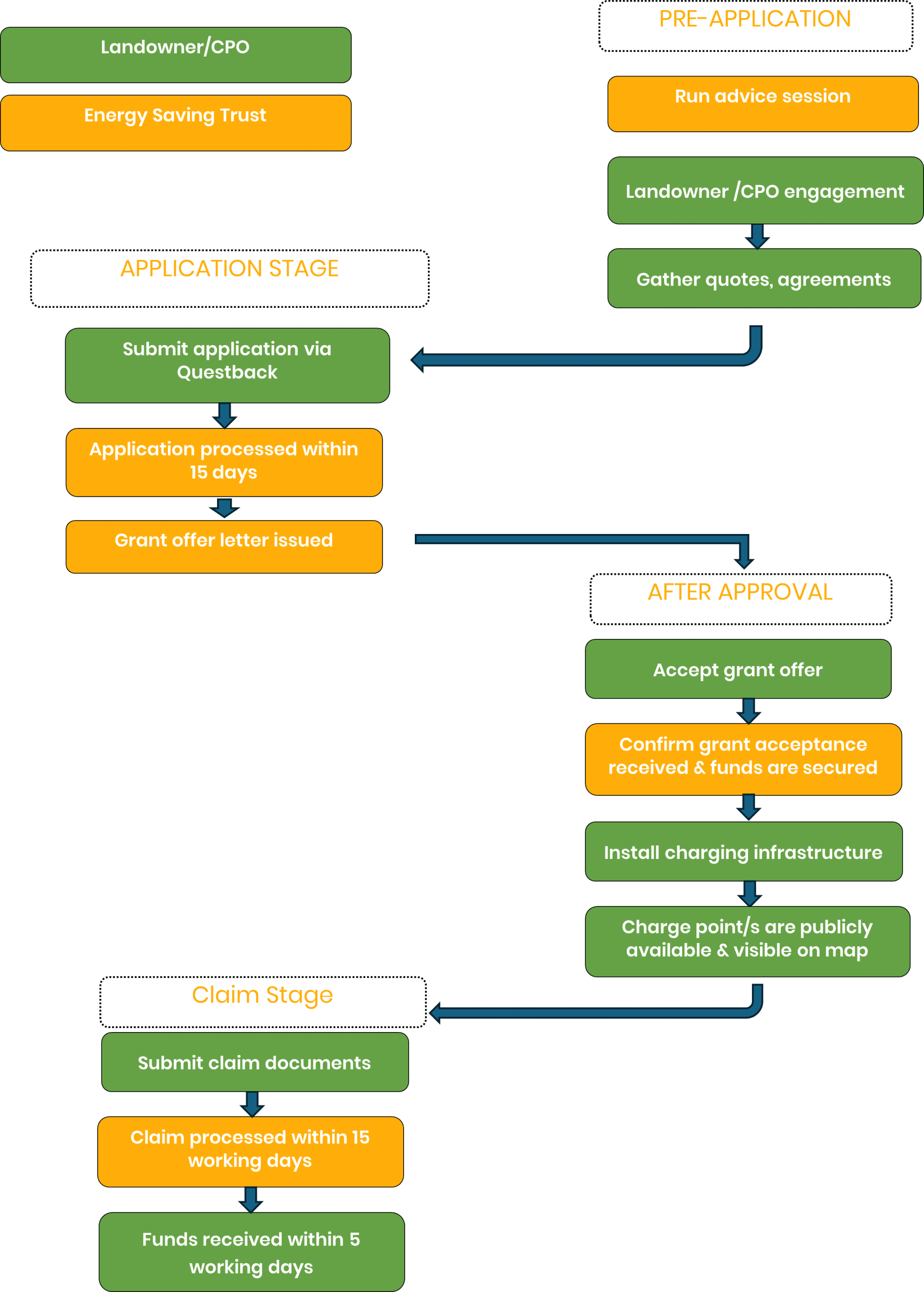
To submit a successful application, applicants must complete an online application form and ensure the following evidence is included:
Quotes for all works to be funded.
If the application is being made by a CPO directly as the grantee, evidence of authorisation to utilise the proposed installation site from the landowning business.
If the application is made by a CPO on behalf of a landowning business, evidence of a formal agreement between the CPO and grantee to apply for funding.
A completed project plan spreadsheet for the relevant applicant funding stream (see below).
Please select the appropriate project plan for your project, this must be completed and uploaded to your online application submission. Any applications received without a project plan are unable to be progressed.
Please note that this list is not comprehensive. You are free to arrange works with other CPOs that do not appear on it.
Our team has hosted a couple of webinars to introduce and help you with the rural and island infrastructure fund. Session cover eligibility, applicaiton support and site accessibility guidance.
What are the charge point infrastructure requirements?
All funded infrastructure must meet the following requirements.
All charge points must be publicly available and appear on a publicly accessible charge point map once installed.
Infrastructure sites must be free from barriers such as gates 100% of the time in which they are deemed publicly accessible.
Clear land ownership must be established and permission for installation(s) to take place provided as applicable.
No installations are permitted on local authority owned land, including trunk roads or locations adjacent to motorways.
Residential properties are excluded, unless the applicant is a business operating from that location.
Projects must be located within very remote small towns, accessible rural areas, remote rural areas, very remote rural areas, (categories 5–8 of the Scottish Government’s 8-Fold Urban Rural Classification) or islands.
Where infrastructure sites do not have a pre-existing point of connection, applicants must provide evidence that a new connection can be delivered in addition to project works being completed before the grant offer letter deadline.
Where signage is requested as part of the funded project, funded signage is to improve public awareness of and access to EV charging facilities only, not to promote individual commercial operators or charging networks.
Given the rural and remote focus of the fund, many locations may see lower levels of EV charging but still play a critical role in ensuring equitable access to EV infrastructure across Scotland. Therefore, site viability will not be based solely on commercial viability.
Site viability will be determined more according to strategic need, by considering factors such as:
Availability of existing charging options nearby.
Whether the site fills a known infrastructure gap in the public network.
The importance of the site to wider connectivity, even if usage is expected to be low.
Mapping and analytics tools will be used to determine site viability and long-term value.
Terms and conditions
We are authorised and regulated by the Financial Conduct Authority. This fund is subject to our full terms and conditions.
Grants are offered on a first come, first served basis and are subject to funding availability. The grant may close, without notice, at any time within the financial year. Making an application does not guarantee an offer of funding will be made.
A copy of the Terms and Conditions issued to successful grantees is available to view. Please note that the Terms and Conditions published above are provided as an example only and may be subject to change.
If you have any questions or if you’re unsure whether your location is eligible for this funding, please contact [email protected]
Funding allocated to date
Local Authority Area
Claims paid
Claims paid (£)
Units delivered
Sockets delivered
Aberdeenshire
11
£415,363.20
20
34
Angus
5
£136,384.60
10
14
Argyll & Bute
24
£769,140.30
44
72
City of Edinburgh
1
£6,470.00
1
1
Dumfries and Galloway
18
£418,159.20
29
48
East Ayrshire
1
£10,754.00
2
2
East Lothian
3
£156,316.00
6
12
East Renfrewshire
2
£78,313.00
4
8
Eilean Siar
5
£260,145.57
9
14
Fife
4
£94,792.11
6
8
Highland
41
£1,198,045.22
73
119
Inverclyde
1
£14,880.00
1
2
Moray
3
£127,079.00
5
10
North Ayrshire
5
£234,509.20
9
15
Orkney Islands
1
£8,912.00
1
2
Perth and Kinross
12
£335,914.78
36
46
Renfrewshire
2
£29,197.67
3
4
Scottish Borders
5
£99,476.64
6
11
South Ayrshire
2
£64,530.00
3
6
South Lanarkshire
2
£59,967.00
2
4
Stirling
8
£252,705.00
17
31
Table last updated 28 July 2026
Last updated: 11 September 2026
Tell us where you live
Get the most relevant content from Energy Saving Trust by telling us where you live