Blog Post 17 November 2026

How Laura installed solar panels to help reduce her carbon footprint

The process was so easy, possibly even easier than fitting a fridge!

Rooftop solar panels are the most common renewable energy technology in the UK, with many homes across the country now using solar energy.

We spoke to our operations director Laura McGadie to find out more about her solar panels, which have been generating renewable electricity for her home in Edinburgh since 2011.

Why did you decide to install solar panels?

We’ve been calculating our carbon footprint for over 20 years, and every year we think about what more we can do. We got to a point where we’d done all the easy things, so the next step was to consider rooftop solar panels.

We used the Home Energy Scotland advice service to find the best energy saving improvement for our home, as we were considering either solid wall insulation or solar panels.

However, we live in a terraced house with little outside wall, so it didn’t make sense to install solid wall insulation. The report from Home Energy Scotland helped us identify that solar panels were the right technology to install.

We installed the panels in 2011, before the Smart Export Guarantee (SEG) was available, so that wasn’t a driver for us. Our motivation was how to cut our carbon footprint. However, when the Feed-In Tariff (FIT) scheme was introduced, we started getting payments for our exported electricity.

Although we haven’t got a big system, the combination of the Feed-in Tariff and energy savings covers our whole electricity cost. We receive the higher FIT rate as we installed our system in the early days of financial incentives for home renewable energy.

Do your panels generate all the electricity you need for you home?

No, they don’t. Our house has a pitched roof but it’s a 1900s property with dormer windows, so there’s not enough roof space to install solar panels on the sloping roof.

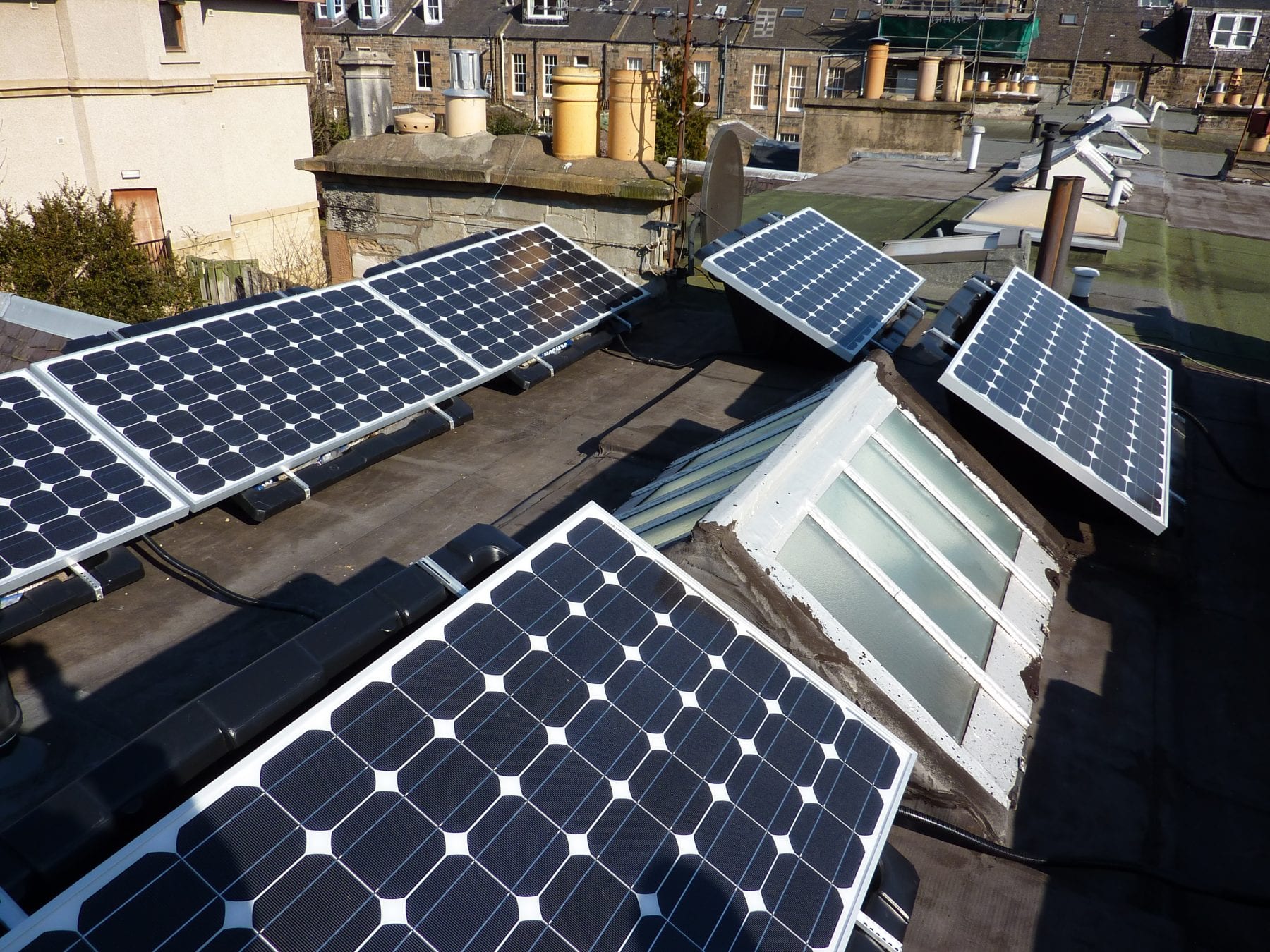
We have a section of flat roof between the sloping roofs, so the solar panels were installed on buckets ballasted to weigh them down. We only had space to install just over 1.5kW of solar panels, and the electricity it generates is roughly one third of our electricity consumption. However, we don’t use it all, as our energy use doesn’t always match up to when the panels are generating electricity.

We export electricity to the grid when we’re not using it. But if we’re using our appliances during the day, we use that electricity instead of relying on the grid.

Because of that, we try and shift our energy use to the middle of the day, especially during the summer, to try to use as much of our own electricity as possible. It’s more financially beneficial for us to use our own electricity than export what we don’t use and buy in from the grid.

Laura McGadie

Do you monitor how much electricity you use vs how much you export?

Yes, we have an import-export meter that was installed at the same time as the solar panels. We have two meters that are linked to the solar electricity generation:

  • One is a generation meter, which measures how much we’re generating.
  • The other is an import-export meter that was installed by our energy supplier and replaced our old electricity meter.

How easy was it to install the solar panels?

After a site visit from Home Energy Scotland, we tried to get three quotes from a list of certified installers provided by Home Energy Scotland at the time, but only two visited our home to give us quotes.

If you live in Scotland, you can now use the Renewables Installer Finder to find MCS certified renewables installers.

We chose the installer who sounded the most knowledgeable about the system. The process was so easy, possibly even easier than fitting a fridge!

Everything was located on the outside of the house, apart from the generation meter and solar inverter, so there was no disruption. We didn’t need planning permission as it’s a permitted development, and the panels aren’t visible from the street.

What’s the main benefit of owning solar panels?

They’ve definitely reduced our carbon footprint, which is what we wanted the system to do. And it just gives you a great feeling knowing that you’re generating your own electricity from a renewable energy source. You can hear the inverter working and there’s a light that flashes faster the more electricity is being generated, which is very satisfying! The best thing about it is feeling like we’re making a difference.

People are also interested in the fact that we’ve installed solar panels. Our children have been able to talk about it for school projects. We’ve now had them for 15 years and nothing has gone wrong! We’ve since installed flat roof insulation and had to move the panels to fit the insulation, but it was fairly easy to do.

While there’s no annual maintenance or service required, the inverter is likely to need replacing at some point.

What advice would you give someone considering installing solar panels?

If you live in Scotland, contact Home Energy Scotland to get advice on the best option for your property, whether it’s solar panels, insulation or something else.

Think about the whole house, think about what’s right for you and your habits. For example, if you’re thinking about solar panels, first consider how you can maximise the benefits of the system. You can do this by changing your energy use to times when the sun is shining, and your system is generating electricity. You might also want to consider battery storage, which will increase the cost but lets you use more of what you generate.

Most importantly, do your research. If your motivation is cutting your carbon footprint, work out where your carbon emissions are coming from. The results can be quite surprising!

Find out more about solar power

Visit our solar hub to learn more about rooftop and plug-in solar panels

Solar hub

Categories:

Last updated: 17 November 2026