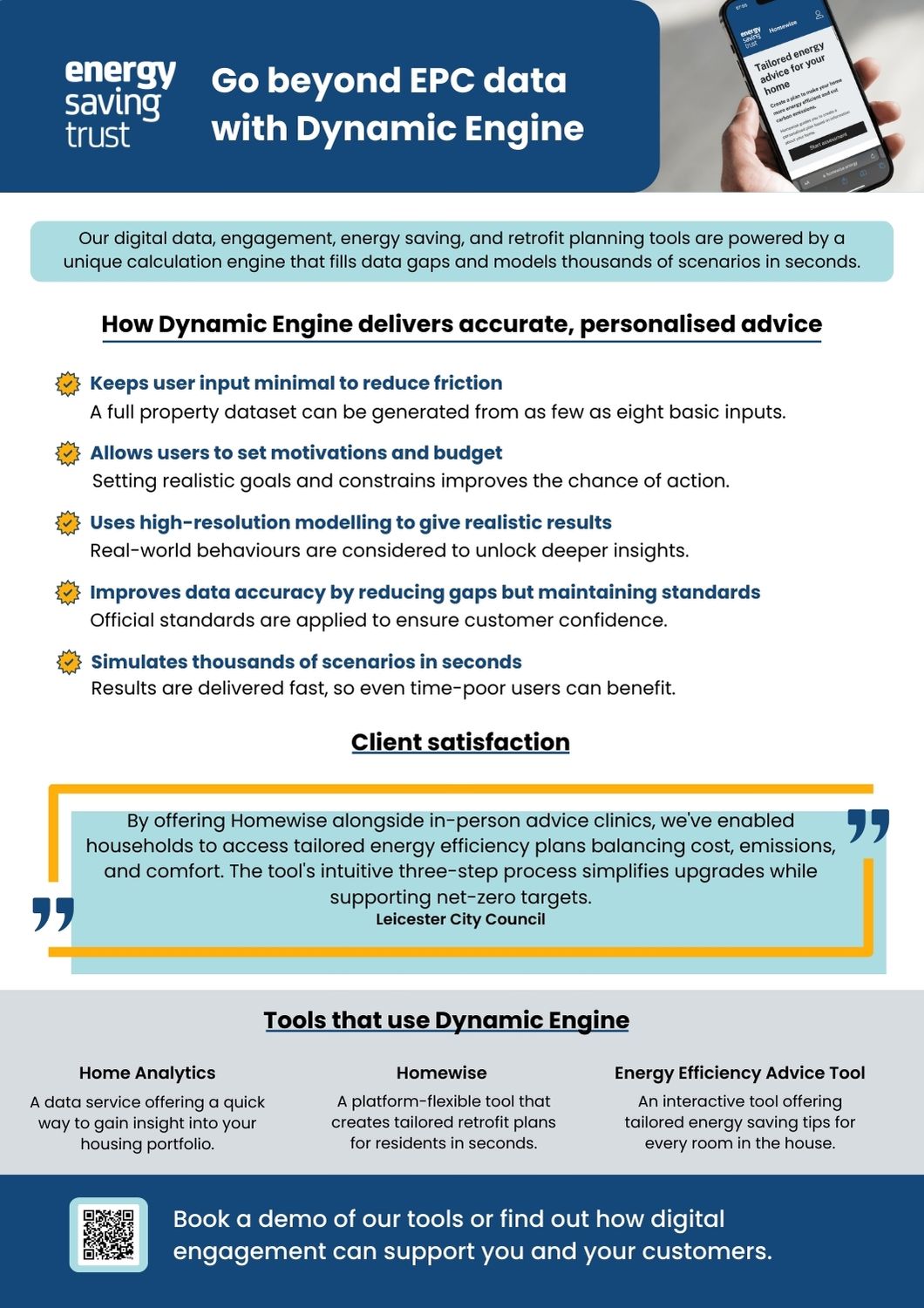
Dynamic Engine can generate a complete property dataset from as few as eight basic inputs, helping organisations deliver personalised home energy advice without lengthy questionnaires or surveys.
Dynamic Engine runs thousands of simulations per home in seconds to identify tailored energy improvement plans based on a property's characteristics, budget and user priorities.
Dynamic Engine uses data from Home Analytics service, which contains more than 90 variables for every property across Great Britain. This improves accuracy while keeping user journeys simple and low effort.
Across the UK, organisations are under pressure to help customers and residents cut energy bills, boost comfort and understand their home’s performance. But inconsistent data, low user engagement and complex technical terminology often get in the way.
Our Dynamic Engine technology could be the key to the success of your engagement programmes.
Here are five ways Dynamic Engine helps organisations deliver accurate, personalised energy advice at scale, without lengthy questionnaires or costly surveys.
What is Dynamic Engine?
Dynamic Engine is a high-performance modelling platform designed to deliver fast, accurate, and tailored home energy and retrofit advice at scale.
It fills data gaps and runs thousands of scenarios in seconds. We use it to power a range of Energy Saving Trust tools used by businesses and local authorities. These tools engage customers, residents and internal teams with reliable, personalised recommendations.
How does Dynamic Engine deliver accurate, personalised advice?
1. User input is minimal to reduce friction
A full property dataset can be generated from as few as eight basic inputs.
Most people either aren’t able or don’t have time to give detailed technical information about their home. Dynamic Engine’s inference module solves this by generating a complete property dataset from as few as eight basic inputs.
With only an address, it can pre-populate property data. It does this by drawing on Home Analytics, our trusted dataset containing more than 90 variables for every property across Great Britain.
This ensures accuracy while keeping user journeys short, simple and low-effort.
About Home Analytics
2. Users can set motivations and budget
Setting realistic goals and constraints improves the chance of action.
Users can shape plans generated by our tools based on what matters most – saving money, cutting carbon, or improving EPC performance. They can also set budget limits and input real energy-use data, letting the model refine its recommendations further.
Because pre-made plans are also available, even time-poor users or those unsure about next steps can benefit from great advice.
Real-world behaviours are considered to unlock deeper insights.
Dynamic Engine goes beyond EPC-level insight. It models electricity demand and solar panel generation at 30-minute intervals, reflecting real-world behaviour across the year. This enables accurate evaluation of:
solar panel potential and export
heat pump suitability
battery storage value
EV charging behaviour
This level of granularity is essential for assessing modern low-carbon technologies and driving awareness of these solutions.
Plus, the more accurate the advice, the more you can educate and engage your users. This will help motivate them to take up any financial support like loans and grants.
Personal solar calculator
Our solar panel calculator gives an idea of how many panels may be needed, how much money could be saved, and how much it may cost to install.
4. It improves data accuracy by reducing gaps but maintaining standards
Official standards are applied to ensure customer confidence.
Our calculation engine is based on the Reduced Data Standard Assessment Procedure (RdSAP). This ensures that outputs remain compatible with official standards, but are enhanced with richer datasets and more intelligent assumptions.
This delivers more accurate and actionable advice while still aligning with the official methodology used by the UK Government to assess home energy performance.
Dynamic Engine is currently built on SAP 2012 (v9.94) and is being upgraded to SAP 10.2. It incorporates bespoke datasets curated by Energy Saving Trust. This includes fuel prices, installation cost databases, system efficiency data, national housing survey property dimensions, and loans and grant scheme information. All data is regularly reviewed and updated to ensure accuracy.
5. Thousands of scenarios are simulated in seconds
Results are delivered fast, so even time-poor users can benefit.
Dynamic Engine runs thousands of simulations per home, rapidly identifying the optimal combination of improvements for each property, budget and motivation.
Users can still manually adjust their plans, maintaining control and ensuring recommendations are both accurate and practical, but results are still delivered fast.
One of the tools that uses Dynamic Engine to allow residents to create tailored retrofit plans in Homewise.
User-centric design at the heart
Putting users at the centre of energy and retrofit engagement is key to long-term success.
Intuitive, low-effort digital tools that reflect real behaviours, like limited time, varied knowledge and different motivations can:
drive higher uptake
reduce drop-off
build trust
By prioritising user experience from the start, organisations:
Deliver better outcomes today.
Ensure communication strategies remain scalable, adaptable and future-proof as expectations, technologies and policy landscapes evolve.
If you’re ready to create digital journeys that genuinely motivate residents and customers to act, let us show you what’s possible.
Book a demo
To explore our Home Analytics and Portfolio Energy Assessment options, or for demos of any of our tools, book a demo or exploratory call with our team today.